Fixed-Price Software Development Can't Be Flexible? Think Again!

Archie Norman
Fixed-price software development can sound reassuring and worrying at the same time.
A predictable budget is useful. But nobody wants to discover they’ve also bought a rigid project where every decision was effectively made before anyone had used the product.
The good news is that cost certainty and flexibility aren’t opposites. A well-planned fixed-cost project can still respond to feedback, change priorities and improve as the product takes shape. The important bit is understanding what is fixed, what can change, and how those changes are handled.
This is how we price work at mmtm, and it's something we're often praised for by our clients as it reduces risk on both sides of the table.
Can fixed-price software development really be flexible? 🔄
Yes. Fixed-price software development describes the commercial agreement around a project. It doesn’t automatically dictate how the software has to be designed or built.
A project can have an agreed budget and delivery plan while still being developed iteratively, reviewed regularly and adjusted when new information appears.
The distinction that matters is between a fixed budget and an unchangeable specification.
If every tiny detail is locked before development starts, flexibility becomes difficult. But if the team agrees on the product’s goals, core functionality and priorities, there can still be room to make sensible decisions during delivery.
Good fixed-cost projects start by reducing uncertainty 🔍
The less you know about a software project, the less trustworthy any fixed-price quote becomes.
That’s why jumping straight from “we have an app idea” to a development quote is rarely sensible.
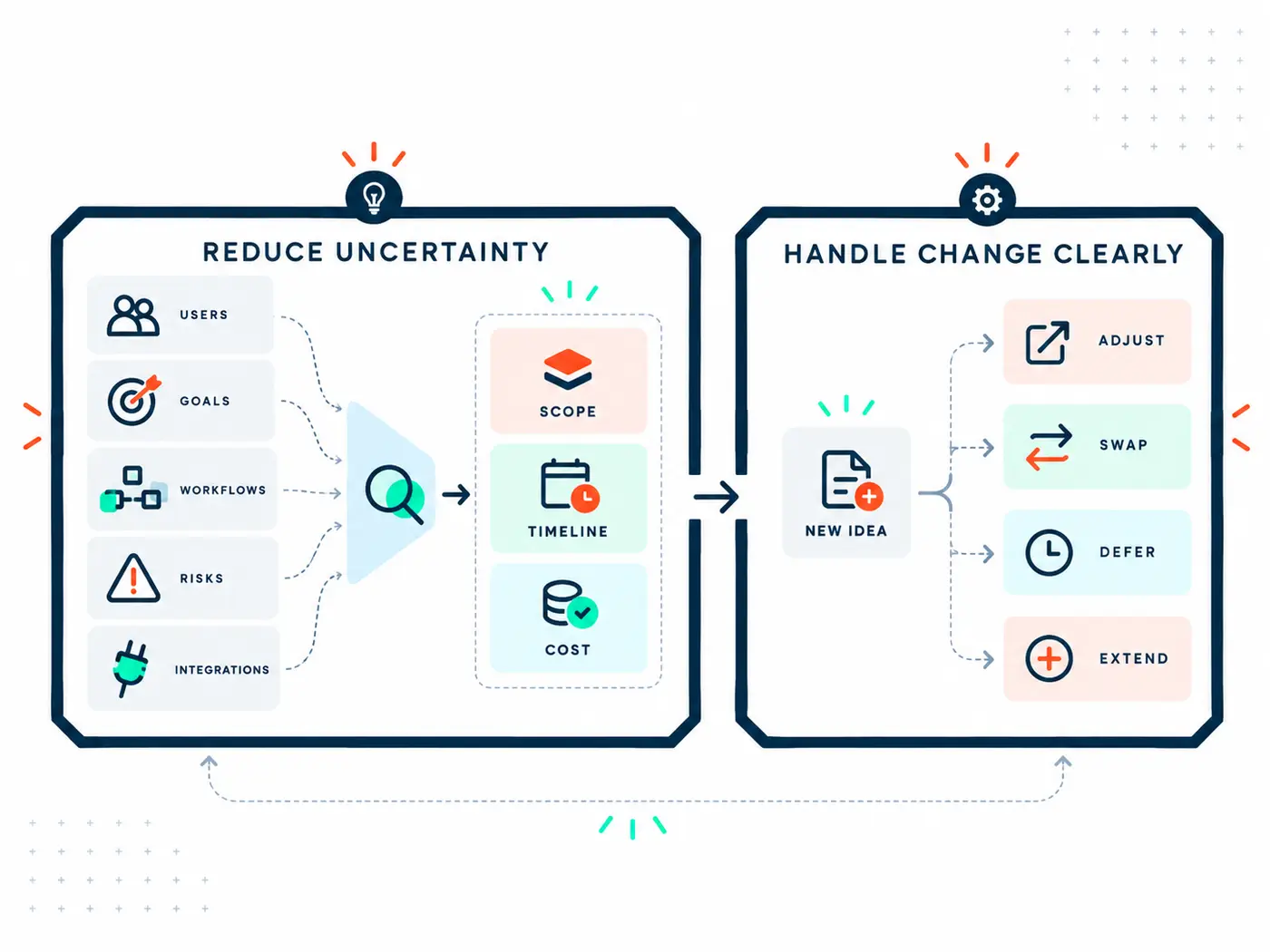
At mmtm, new product work always begins with a focused discovery phase. We use it to understand the users, business goals, workflows, priorities, risks and technical questions before serious development begins.
For a new product, that process can produce a prioritised first-release scope, product designs and a technical delivery plan with a phased timeline and indicative cost.
Discovery doesn’t magically remove uncertainty. Software will always contain some unknowns. What it does is expose the important ones early, when they’re much easier to discuss and manage.
That gives everyone a far better basis for answering questions such as:
- What absolutely needs to be in the first release?
- What would be useful, but could wait?
- Which assumptions still need testing?
- Are there integrations or technical constraints that need investigating?
- What level of investment makes commercial sense?
A fixed-cost quote is much more useful when those conversations have already happened.
Flexibility comes from priorities, not an unlimited scope 🎯
One misconception about flexible software development is that flexibility means being able to add anything at any time without affecting the budget or delivery date.
Unfortunately, some maths still applies. 😅
If a two-month piece of work suddenly gains another month of requirements, something has to change. The useful question is what changes?
In a healthy project, there are usually a few options:
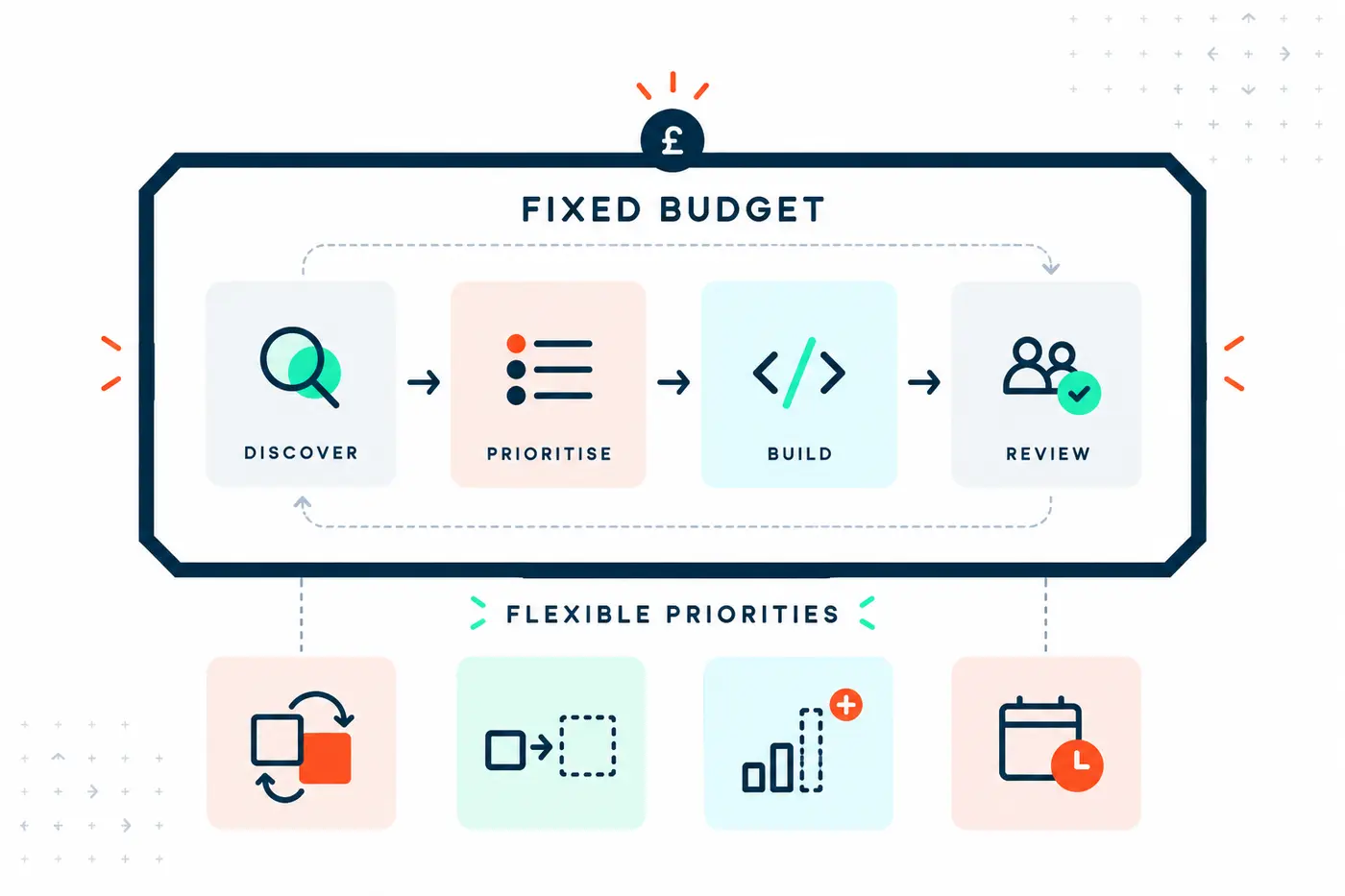
- Swap priorities: add the newly important feature and move a lower-priority feature into a later phase.
- Simplify the solution: achieve the same business outcome with a smaller piece of functionality.
- Extend the scope: agree the additional cost or time before the extra work begins.
- Defer the decision: launch, gather real user feedback and decide whether the feature is actually necessary.
This is why prioritisation matters so much. When a project has a clear view of what is essential and what isn’t, the team has options when circumstances change.
Without that prioritisation, every feature becomes “must-have”, which is usually where fixed-cost projects become painful.
Fixed price doesn't mean waterfall development 🚰
Another common assumption is that a fixed-cost project must follow a traditional waterfall process: specify everything, build everything and reveal the result at the end.
It doesn’t.
The original Manifesto for Agile Software Development explicitly values responding to change and customer collaboration. Those principles are perfectly compatible with an agreed project budget, provided the delivery process makes room for feedback and sensible trade-offs.
At mmtm, our development process uses focused discovery, two-week sprints and regular review. Each sprint is planned around priorities and checked through QA before important changes reach users.
That means you’re not waiting until launch day to discover whether the product feels right.
You can see it taking shape, test assumptions and discuss what the team has learned along the way.
What happens when you change your mind mid-project? 💭
You probably will. That’s normal.
A workflow that looked obvious in a specification might feel awkward once you can click through it. Early users might highlight a need nobody anticipated. A third-party integration might behave differently from its documentation.
The answer shouldn’t be “you signed off the specification, tough luck”.
Instead, the team should look at the impact of the change.
A small adjustment may fit comfortably within the existing work. A larger change may require another feature to move out of the first release. A genuinely new requirement may need extra time and budget.
What matters is that this is discussed before the work happens.
You shouldn’t receive an unexpected invoice several weeks later and discover that a casual conversation somehow became five days of additional development.
Fixed-cost development shouldn't encourage technical shortcuts 🛠️
There’s another risk worth watching: a team racing towards a fixed deadline by choosing the quickest possible implementation every time.
That can create technical debt (short-term decisions that make the software harder or more expensive to change later).
A first release doesn’t need to solve every theoretical problem your business might encounter in five years. Over-engineering can waste just as much money as under-engineering.
But the foundations should make sense for what you already know about the product and where it is likely to go.
At mmtm, we build bespoke Ruby on Rails applications with maintainability in mind and can continue supporting and improving products after launch. The goal isn’t simply to cross a finish line; it’s to leave you with software that can keep moving forward.
You can read more about how we take new products from discovery through design, development and launch.
When fixed-price software development isn't the right choice ⚖️
Fixed cost isn’t automatically the best commercial model for every piece of software work.
It becomes much harder to price responsibly when the work contains major unknowns. For example, you may be experimenting with unfamiliar technology, investigating a poorly documented legacy system or exploring a product whose requirements are deliberately changing every week.
In those situations, trying to force certainty too early can create a misleading quote rather than a useful one.
A better approach may be to split the project into stages: investigate the risky parts first, learn from them, then price or plan the next phase with better information.
That’s also why preparing properly before a custom web app build matters. The objective isn’t to make your specification longer. It’s to make the important decisions clearer.
What should you expect from a fixed-cost software partner? 🤝
If you’re comparing development partners, don’t just ask for the final number. Ask how they arrived at it.
A credible team should be able to explain:
- What assumptions the estimate is based on.
- What is included and excluded from the proposed scope.
- How priorities were decided.
- How you’ll see and review work during development.
- What happens when requirements change.
- How additional work will be discussed and approved.
- How the application will be supported after launch.
If the price is very precise but the product itself is still vague, that’s worth questioning.
The most useful fixed-cost projects don’t pretend change won’t happen. They create a clear framework for dealing with it.

Martin Dick
Co-Founder, mmtm
Want a clearer idea of what your software project should cost?
A useful estimate starts with understanding what you're trying to achieve, what needs to be in the first release and where the genuine unknowns are.
At mmtm, we can help turn an early idea into a practical product plan, with clearer priorities, technical direction and a sensible route to delivery.
Talk through your product ideaFrequently Asked Questions
Is fixed-price software development really fixed?
The agreed price normally relates to an agreed scope and set of assumptions. Small decisions may be handled within the project, while significant new requirements may mean reprioritising existing work or agreeing additional time and budget. The important thing is having a clear change process from the start.
Can an agile software team work to a fixed budget?
Yes. Agile delivery and a fixed budget aren't mutually exclusive. A team can work iteratively, review progress regularly and respond to feedback while operating within commercial boundaries. Prioritisation is what makes this practical.
What happens if our requirements change during development?
First, assess the impact. You may be able to swap a lower-priority feature, simplify the new requirement or move it into a later release. If the change genuinely adds substantial work, the team should explain the effect on cost and timing before proceeding.
When is fixed-price software development a bad fit?
It can be a poor fit when the project contains major unresolved technical questions or the product requirements are intentionally changing very quickly. In those cases, a discovery or investigation phase followed by staged delivery can be more realistic than trying to price everything upfront.
How can we get a more accurate software development estimate?
Reduce uncertainty before asking for a final quote. Clarify the business goal, users, essential workflows, priorities, integrations and technical risks. A structured product discovery workshop can turn those decisions into a much stronger delivery plan.
Not Sure What To Read Next? Here's What We Recommend...
- App Development
- Product Discovery
- Agile Development
- Software Consultancy