Why Ruby on Rails Remains a Smart Choice in the Age of AI

Archie Norman
AI is changing how web applications are built, and it’s made the choice of web framework more important than ever.
At mmtm, we use the Ruby on Rails framework to build, upgrade and maintain high-quality web applications for our clients. And in the age of AI-assisted development, Rails is looking more relevant than ever.
Why Rails works well with AI
Ruby on Rails has always valued clarity, convention and productivity.
That matters when using AI tools. Rails applications tend to follow familiar patterns, include testing as part of the framework, and produce code that’s relatively easy for experienced developers to read, review and improve.
The coding language, Ruby, is token-efficient (up to 40% more so than other languages such as Python, in fact), and well-suited to AI-assisted workflows. AI can help with tests, refactoring, documentation and repetitive development tasks without blowing through token limits, while our developers stay focused on architecture, judgement, security and product quality.
This means our skills can be dedicated to design, UX, and making the best strategic decisions for the digital products we create and enhance.

What this means for our clients
For clients, the benefit is practical.
Rails helps us move quickly without sacrificing maintainability. AI can support that process by speeding up some of the lower-risk parts of development, especially in well-structured applications.
This is particularly useful for maintenance, upgrades, and web application development. Meaning clearer estimates, faster iteration and better long-term support.
The important point is this: AI is most useful when the foundations are already strong.
A messy web application doesn’t become good because AI touches it. A well-built Rails application, however, gives both developers and AI tools a clearer structure to work with.
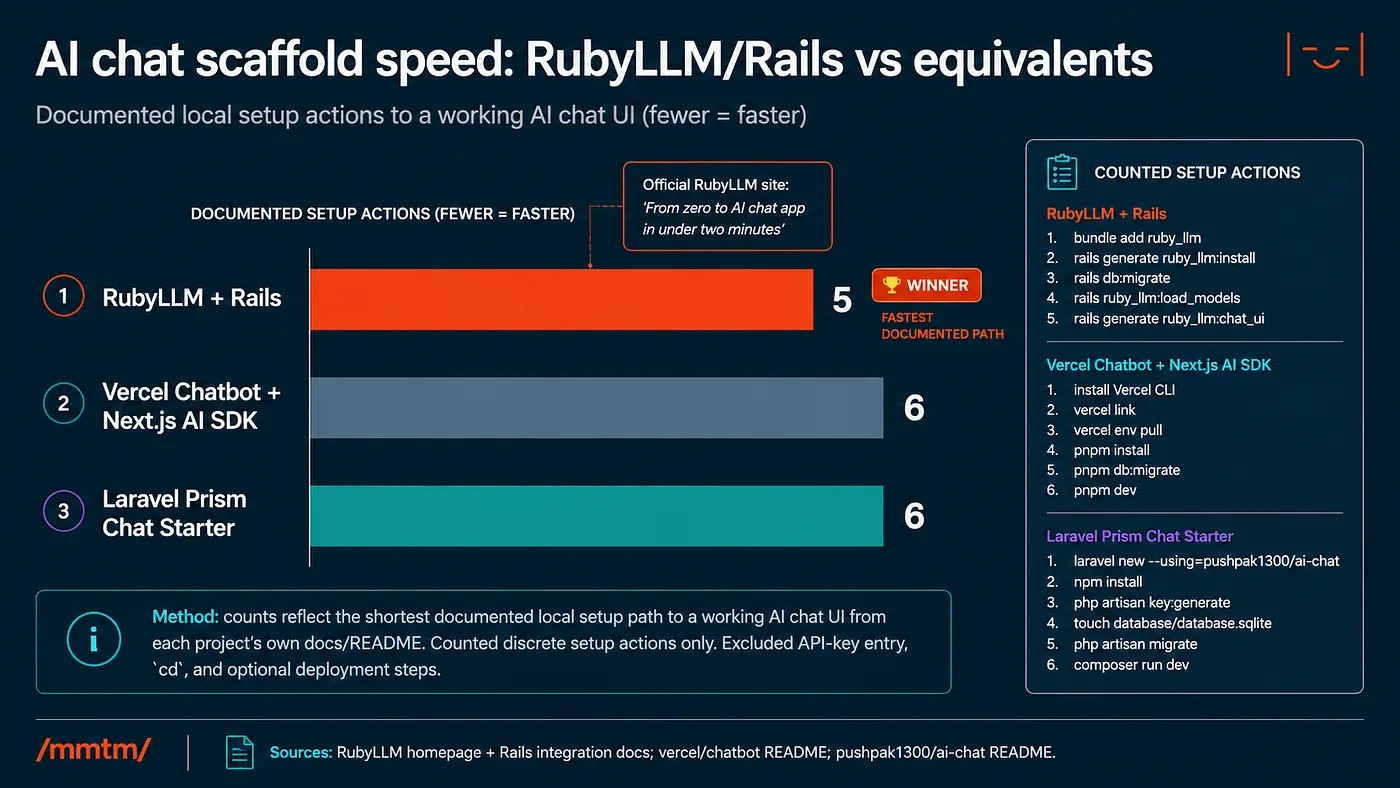
Rails is still moving forward
The latest Rails releases continue to focus on reliability, maintainability and developer productivity. Rails 8.1 is already available, with Rails continuing to evolve as modern web development changes. And we’re anticipating even further AI-friendly features as the framework grows towards Rails 9.
That makes Rails a strong choice for businesses that want a serious, long-term platform rather than a fragile prototype.
Our view
Ruby on Rails isn’t the right answer for every project.
Some products need different tools. But for the kind of work we do at mmtm (reliable web applications, business-critical platforms, upgrades, maintenance and long-term product partnerships), Rails remains one of the strongest choices available - and AI only makes that case clearer.

Martin Dick
Co-Founder, mmtm
Need a second opinion on your Rails application?
We've spent the last 10+ years helping businesses build and grow web applications, supporting hundreds of thousands of users.
If you're planning new features, tackling technical debt, improving performance, or exploring where AI fits into your product, I'd love to share some ideas!
Book a call with MartinFrequently Asked Questions
How can I improve an existing Ruby on Rails application?
mmtm works with businesses that already have Ruby on Rails applications and need help improving them. That can include fixing performance issues, upgrading older Rails versions, improving UX, adding new features, reducing technical debt, or making the product easier to maintain long term.
What's the best way to support and maintain a Ruby on Rails app?
The best way to support and maintain a Ruby on Rails app is to keep the codebase, framework version, dependencies, hosting setup and test coverage under regular review. For business-critical applications, it also helps to have a Rails team that can fix issues, plan upgrades, improve performance and continue developing the product over time.
How do I know if my Rails app needs an upgrade or rebuild?
If your application is slow, hard to change, expensive to maintain, running on an old Rails version, or causing regular issues for customers or your team, it’s worth reviewing properly. A rebuild isn’t always the answer. Often, the right plan is a focused set of upgrades, refactoring and product improvements.
Can AI features be added to a web application?
Yes. AI features can be added to many existing web applications, including Ruby on Rails apps. Common examples include document processing, workflow automation, content tools, internal assistants, chat interfaces and integrations with large language models. The right approach depends on the product, the data involved and the business problem the AI feature needs to solve.
Not Sure What To Read Next? Here's What We Recommend...
- AI
- Ruby on Rails
- Web Development
- Productivity