Enterprise-Level AI Data Analysis: Under the Hood of Aideon AI

Nitin Sidhu
Most business users don’t want to write SQL queries or navigate complex dashboards; they just want clear answers from their data. That’s exactly what Aideon AI delivers: a natural language interface to databases and business documents.
Teams can simply ask questions in plain English and get answers back as tables, charts, or exportable reports. Whether data lives in the cloud, in on-premises databases, or within business documents, Aideon makes it accessible and actionable.
Here it is in action! 👇
The Technology Behind Aideon AI
At its core, Aideon is built using popular Python web frameworks like Django and FastAPI, giving it both reliability and flexibility. The natural language interface is powered by large language models (LLMs) from OpenAI by default, while caching, queuing, and vector store services such as Qdrant ensure speed and scalability.
Importantly, Aideon’s LLM framework is modular by design. That means we’re not limited to one provider - we can plug in alternatives such as Meta LLaMA, or even integrate directly with an enterprise’s own LLM infrastructure, which might be fine-tuned to the organisation’s own data. This makes Aideon adaptable to the evolving AI landscape and customisable for businesses with specific requirements.
From Question to Answer: What Happens Behind the Scenes
The user experience is deliberately simple: type a question, get an answer. Behind the scenes, though, a lot is happening.
When a user submits a question, say, “What were our total sales by region last quarter?” Aideon’s AI engine first retrieves the relevant database schema or knowledge documents using RAG, which also helps narrow down the context. Aideon looks up the database schema via its vector index and identifies relevant tables such as orders and regions. It then generates an optimised SQL query (or knowledge-based response) and executes it.
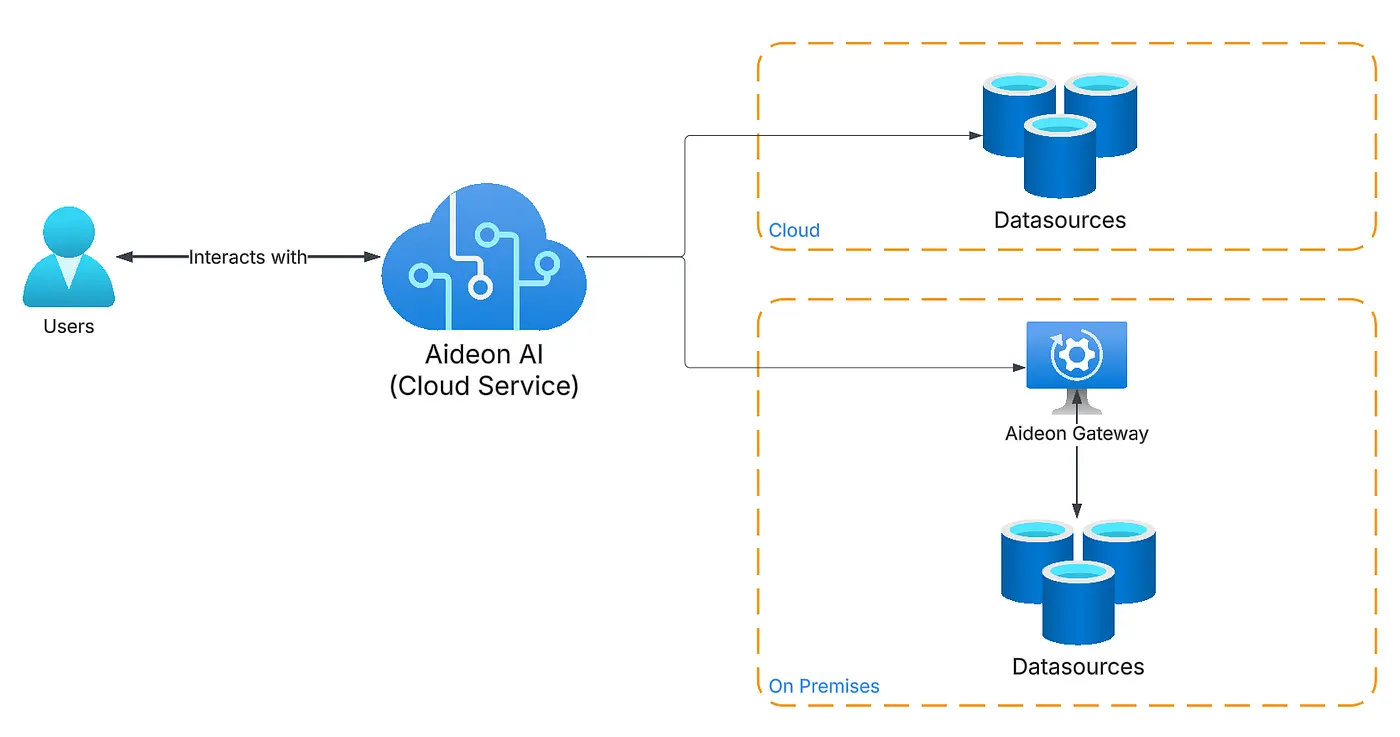
If the database is hosted on-premises, the query is executed securely through the Aideon Gateway Agent, which connects the app to local systems without exposing them to the public internet. To keep responses fast, Aideon combines schema caching (avoiding repeated scans), retrieval-augmented generation (focusing queries on the most relevant tables), and asynchronous request handling (processing many queries in parallel). Together, these optimisations ensure that answers, whether tables, charts, or scheduled reports, are delivered within seconds, even under heavy enterprise workloads.
Data Security by Design
In enterprise environments, security is non-negotiable. Aideon was designed with this in mind:
- Customer data is never stored - queries run live, and results remain visible only to the user.
- On-premises databases remain private, thanks to the secure Gateway Agent.
- Role-based access and datasource tagging ensure that the right people see the right information. For example, Finance users might only see finance-tagged datasources, while Operations sees operational data. This separation reduces risk and ensures teams only work with what’s relevant to them.
- End-to-end encryption protects all communication between users, the cloud application, and gateways.
The result? Enterprise-grade data security without compromising usability.
What’s Next for Aideon AI
AI technology is evolving quickly, and so is Aideon. We’re focused on:
- Enhancing multi-turn conversations that adapt to ongoing business context.
- Expanding industry-specific term mapping, so the system understands the evolving language your teams use.
- Leveraging ever-lighter, more optimised models for even faster and more cost-efficient query generation.
- Building integrations with network management systems (NMS), observability platforms, and cloud storage tools like SharePoint.
- Supporting custom integrations tailored to the needs of our individual users.

Martin Dick
Co-Founder, mmtm
Want faster answers from your business data?
We've spent 10+ years building bespoke web applications, smarter workflows and AI-powered tools for UK businesses. With Aideon AI, we’ve taken that same practical approach to data analysis.
If your reporting is slow, coding-dependent or spread across too many systems, I’d be happy to show you how Aideon could work for you!
Book an Aideon AI demoFrequently Asked Questions
What is AI data analysis?
AI data analysis uses artificial intelligence to help people interpret data and generate useful outputs such as tables, charts or reports, just by asking questions. It's most useful when it connects to real operational data and helps non-technical users get answers without waiting for manual analysis or SQL support.
Is AI data analysis secure for business databases?
It can be, but security depends on how the system is designed. Look for live querying rather than unnecessary data storage and encrypted communication. For on-premises databases, a secure gateway (such as that used by Aideon AI) can help avoid exposing internal systems to the public internet.
Do you need coding knowledge to use AI data analysis tools?
No! The whole point of a natural language AI data analysis tool is to let you ask business questions and receiving useful results without writing SQL commands or scripts.
Not Sure What To Read Next? Here’s What We Recommend...
- AI
- Productivity
- Data Analysis
- Our Products